
Most people use these two words as if they mean the same thing. They don’t. Even Netflix lists both under one “subtitles” menu.
Here is the short answer. Closed captions write out speech and sounds in the same language. Subtitles translate the dialogue into another language. Pick the wrong one, and you may lose viewers or miss a legal rule.
Table of Contents
Subtitles vs. Closed Captions: What Is the Difference?
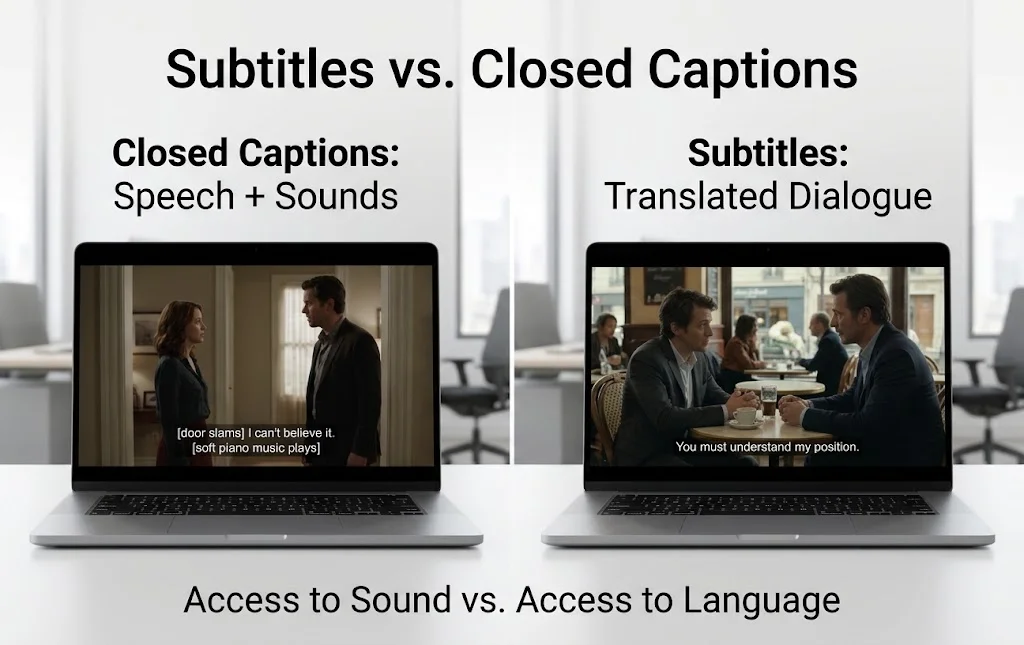
The subtitles vs. captions difference comes down to purpose. One gives access to sound. The other gives access to language.
What are closed captions? They are a text version of the audio track. They show dialogue, sound effects, music cues and speaker identification. A line like [door slams] or [soft piano music] is a caption. They are built for viewers who are Deaf or hard of hearing.
What are subtitles? They translate spoken words into the viewer’s language. A French film with English text is the classic case. Subtitles assume the viewer can hear. So they skip sound cues.
Here is a quick side-by-side:
| Closed captions | Subtitles | |
|---|---|---|
| Language | Same as the audio | Different from the audio |
| Sound cues | Yes | No |
| Main goal | Accessibility | Translation |
| Assumes viewer can hear? | No | Yes |
| Can viewers turn them off? | Yes (closed) | Usually yes |
What does SDH mean? SDH stands for subtitles for the deaf and hard of hearing. It blends both. It uses the same language as the audio, like captions. But it appears as a subtitle track. You will often see it on streaming apps.
What is the difference between open and closed captions? Open captions are burned into the video. You can’t turn them off. Closed captions (CC) sit in a separate file. Viewers switch them on or off.
A few more terms help here:
- Forced narrative subtitles translate only the foreign lines, such as a text message shown on screen.
- CEA-608 is the older analog TV standard. CEA-708 is the digital standard, and it allows custom fonts and colors.
- Pop-on captions suit pre-recorded video. Roll-up captions suit live events.
Why do the terms get mixed up? In the US, “subtitles” means translation. In the UK, the word often covers captions too. Streaming menus blur the line even more.
If you’re creating engaging video content for the fall season, pairing accessible videos with festive social media posts can help your content connect with more viewers. For seasonal inspiration, explore these cute and spooky pumpkin captions to make your autumn photos, pumpkin patch visits, and Halloween posts stand out.
Closed Captions vs. Subtitles: Which One Should You Use?
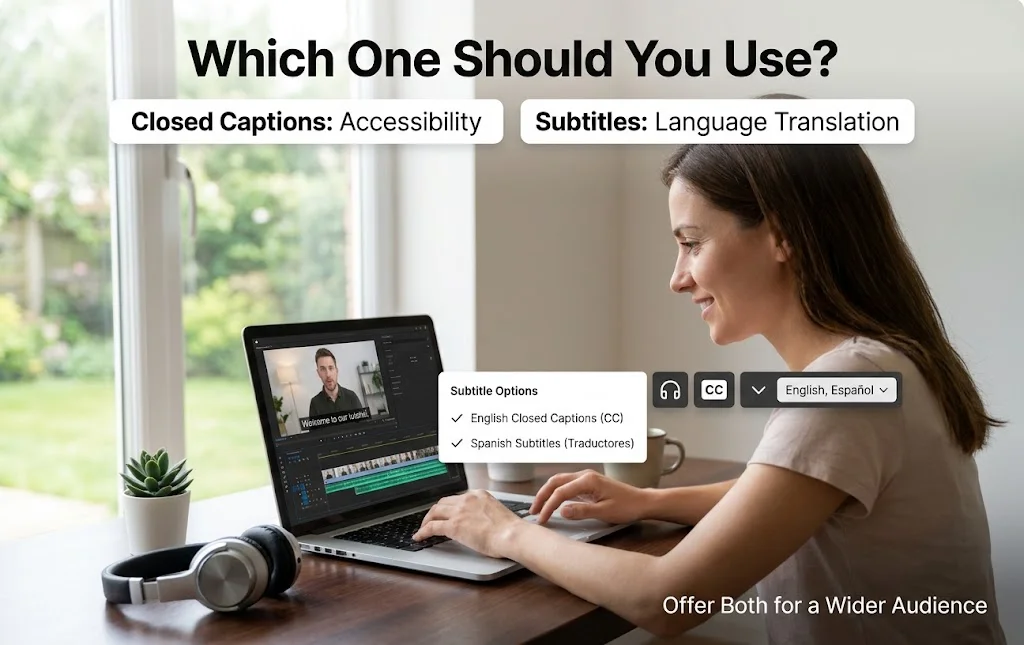
Your audience decides. Ask two things: can they hear, and do they speak the video’s language?
When should you use closed captions? Use them when:
- You want video accessibility for Deaf and hard-of-hearing viewers.
- Your video autoplays on mute. About 85% of Facebook videos are watched without sound.
- You must meet ADA or Section 508 rules.
- You want better viewer retention. Captions can lift view time by about 12%.
When should you use subtitles? Use them when:
- Your viewers speak other languages.
- You sell or teach in global markets.
- You help language learners. Studies show subtitles can improve comprehension when the text matches the learner’s level.
Can you use both on one video? Yes. This works well in the US. Offer English closed captions plus Spanish subtitles. Viewers pick the track they need.
Many viewers use text by choice, not need. Over 80% of people who watch with captions on do so out of preference. A US survey also found about half of Americans watch with subtitles most of the time.
How are captions made? There are three main ways:
- Respeaking: a captioner repeats the speech into software. It is used for live events.
- Stenography: a captioner types shorthand on a stenotype machine. It is also used for live work.
- Typing and timing: a captioner types from scratch and syncs each line. It is used for pre-recorded video.
Are AI captions good enough? Auto-captions save time. But they often miss names, jargon and sound cues. A human check fixes that.
Where can you add them? Platforms like YouTube, TikTok, Instagram and Facebook all let you upload a caption file or edit auto-captions. Common file types are SRT and WebVTT. These are called sidecar files. They sit beside the video instead of inside it.
Accessible communication goes beyond choosing between subtitles and closed captions—it also means using inclusive language that respects and celebrates everyone’s identity. If you’re looking for meaningful ways to promote visibility and acceptance on social media, these Intersex Awareness Day captions for Instagram offer empowering and inspiring words to help spread awareness and support inclusion.
Subtitles vs. Closed Captions: US Rules and Common Mistakes
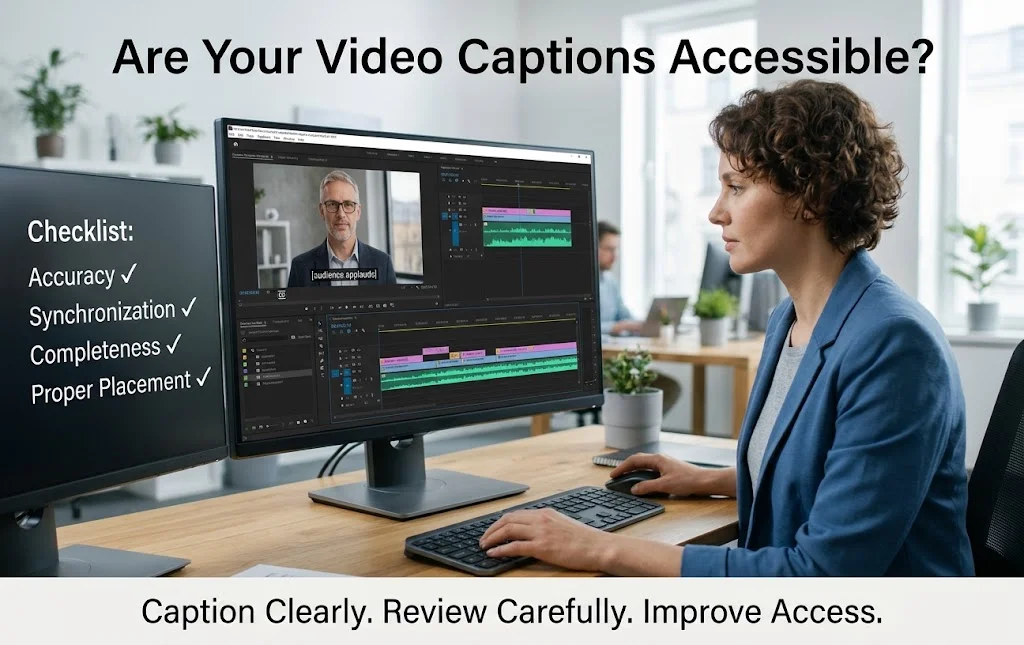
US law cares about access. That points to captions, not translation-only subtitles.
Does the ADA require closed captions? The Americans with Disabilities Act requires equal access to communication. The ADA website explains how this applies to digital content. In 2024, the Department of Justice finalized a rule for state and local governments, including public schools and universities. It points to WCAG 2.1 Level AA. That standard requires captions on pre-recorded video. See the W3C WCAG guidelines.
The rule’s first deadline was April 2026, with a later one in April 2027 for smaller entities. Some reports say the larger-entity date moved to April 26, 2027. Check ADA.gov for the current date.
Does this affect private businesses? The 2024 rule covers public entities. But courts have applied the ADA to web video in private cases for years. So captions are the safer path.
What is Section 508? It covers federal agencies and their content. Learn more at Section508.gov. Many marketers don’t know it exists. One survey found 50% did not think such a law applied.
What do FCC rules say? The FCC sets four quality standards for TV captions: accuracy, synchronicity, completeness and placement. The CVAA also extends caption rules to some TV shows streamed online.
What mistakes make you “use the wrong one”? Watch for these:
- Using subtitles when your viewers need captions.
- Leaving out sound cues like [applause] or [phone rings].
- Letting captions drift out of sync with the audio.
- Placing text over key visuals or faces.
- Publishing raw AI captions with no review.
- Skipping a transcript for audio-only content.
- Mislabeling tracks. Mark them clearly, such as “English [CC]” or “English [SDH].”
What are good caption habits? Keep lines short, about two lines at a time. Use plain fonts and strong contrast. Leave each caption on screen long enough to read. Name speakers when they are off screen.
FAQs
What is the main difference between subtitles and closed captions?
Closed captions transcribe speech and sounds in the same language. They help viewers who can’t hear the audio. Subtitles translate dialogue into another language. They help viewers who can hear but don’t understand the language.
Are closed captions and subtitles the same thing?
No. Many apps group them in one menu, so they look alike. But captions include sound cues and speaker labels. Subtitles only translate dialogue. SDH subtitles combine both.
Do I need closed captions or subtitles for ADA compliance?
You need captions. Access rules point to text that includes sound cues, not translation alone. Check the latest ADA.gov guidance for your type of organization.
Are YouTube auto-generated captions good enough?
Often, no. They can misspell names and skip sound cues. Edit them before you publish. This matters most for education, health and legal content.
Can I use both subtitles and closed captions on the same video?
Yes. Many US creators offer English closed captions and Spanish subtitles together. Viewers choose a track in the video’s settings menu.
Conclusion
Closed captions give access to sound. Subtitles give access to language. Match the tool to your viewer, your video and the law. When in doubt, start with accurate closed captions. Then add subtitles for the languages your audience speaks.

Abroy Ehtisham is a dedicated website Captions Orbit author and content lead who specializes in crafting engaging, highly detailed, and insightful digital content designed to cut through online noise. Driven by a deep commitment to audience-first communication, clear narrative structuring, and thorough research, Abroy explores the evolving landscape of web culture, online media, creative strategy, and community building.